
Table of Contents
- The Historical Trap of Enterprise E-Waste
- The Efficiency Inversion: Performance-per-Watt is the New Core Count
- Shifting Resilience from Hardware to Software Architecture
- The Aesthetics of Digital Sovereignty: Blending Infrastructure into Life
- The Transition: How to Plan the Disappearance of Your Lab
- The Tower Has Fallen. Long Live the Cluster.
For years, the undisputed rite of passage for any serious self-hoster was the acquisition of “The Rack.”
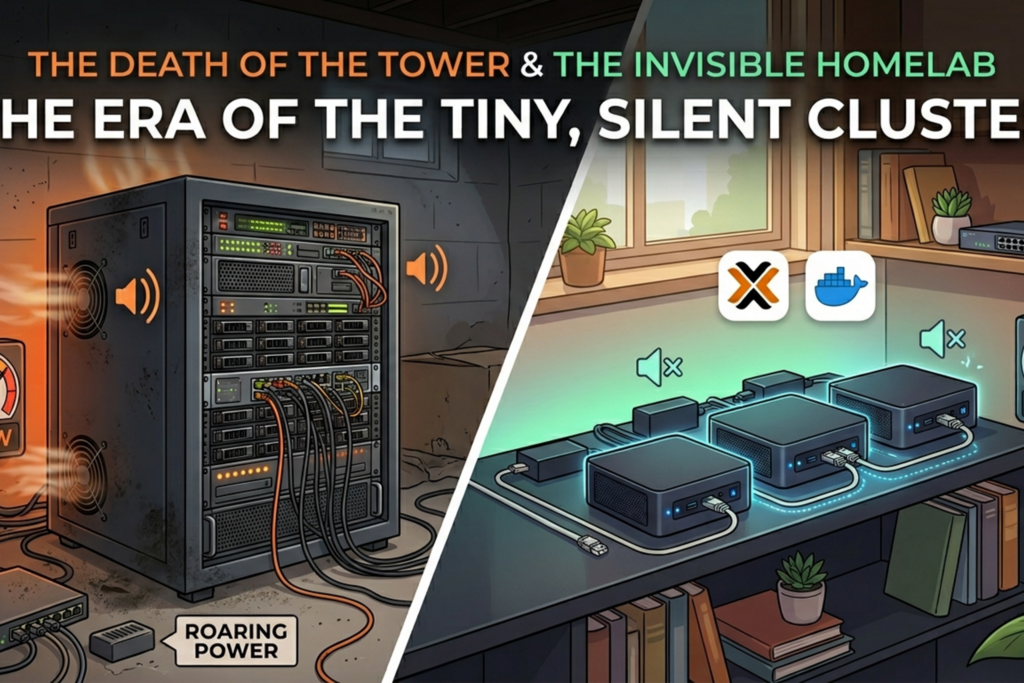
It was a beautiful, chaotic, and loud era. We proudly scoured secondary markets for enterprise-grade hardware, bringing home decommissioned 2U and 4U servers that had spent their first lives in climate-controlled corporate datacenters. We stacked them high in our basements, garages, or spare closets. We listened to the jet-engine roar of 40mm cooling fans screaming at 15,000 RPM during boot, and we watched our household electricity meters spin like ceiling fans.
We wore the 200-watt to 400-watt idle power consumption like a badge of honor. If your household wasn’t complaining about the sudden ambient heat radiating through the floorboards, or the distinct low-frequency hum vibrating through the drywall, were you even really a sysadmin? The physical presence of the hardware was the point. It was tangible, heavy, and undeniably powerful.
But as we navigate the tech landscape of 2026, that era is officially dead.
The modern homelab has undergone a radical, irreversible evolutionary shift. It is no longer a roaring tower hidden away out of shame and necessity. The ultimate architectural achievement today isn’t how much physical space your lab occupies, but how little space it takes up relative to what it can achieve. The goal is no longer to build a miniature enterprise datacenter in your house. The goal is to build a lean, hyper-efficient, resilient private cloud that blends seamlessly into your living space.
Welcome to the era of the Invisible Homelab.
The Historical Trap of Enterprise E-Waste
To understand why the self-hosting philosophy has changed so drastically, we have to look back at why we fell in love with enterprise hardware in the first place. For over a decade, the math of self-hosting was simple: consumer hardware lacked the stability, the memory capacity, and the virtualization extensions required to run a complex home environment.
If you wanted to run a hypervisor like Proxmox VE or VMware ESXi with dozens of isolated virtual machines, consumer-grade desktop towers simply didn’t cut it. They lacked ECC (Error-Correcting Code) memory, their consumer chipsets lacked sufficient PCIe lanes for high-speed storage array controllers, and their single-port onboard Realtek NICs were notoriously unreliable under heavy network loads.
Enter the enterprise surplus market. Decommissioned corporate servers offered everything a homelabber dreamed of:
- Massive Memory Capacities: Dozens of DIMM slots allowing for hundreds of gigabytes of cheap, registered DDR3 or DDR4 ECC RAM.
- True Out-of-Band Management: Integrated systems like IPMI, iLO, or iDRAC that allowed you to power cycle, reconfigure, and access the BIOS of a server entirely through a web browser, even if the underlying operating system had completely crashed.
- Unparalleled Expansion: Hot-swappable drive bays, redundant power supplies, and multi-port Intel network interface cards.
It felt like a cheat code. For a few hundred dollars, a hobbyist could acquire infrastructure that originally cost corporate enterprises tens of thousands of dollars.
The Hidden Costs of Corporate Iron
However, this golden age of cheap enterprise iron came with a massive catch that many self-hosters intentionally ignored for years: the total cost of ownership (TCO) was astronomically high.
Enterprise servers are designed with an entirely different set of constraints than household appliances. In a commercial datacenter, power efficiency is calculated at scale, cooling is managed by massive industrial HVAC units, and acoustic noise is completely irrelevant because humans only enter the room wearing hearing protection.
When you transplant that hardware into a residential home, those design constraints become direct liabilities. A typical dual-socket Intel Xeon server from the E5-2600 v3 or v4 era might draw 150W to 250W at absolute idle.
In regions with high electricity costs, running that server 24/7/365 translates to hundreds of dollars a year just to keep the lights blinking. Add in the secondary cost of running your home’s air conditioning harder during the summer to combat the thermal output of the server, and the “cheap” secondhand hardware quickly becomes a financial black hole.
Furthermore, these systems were structurally inflexible. They demanded deep racks, proprietary mounting rails, and specific power distribution units (PDUs). They were heavy, rigid, and anchored self-hosters to a specific physical location. If you rented an apartment or moved frequently, transporting a 100-pound 24U rack was a logistical nightmare.
The homelab had become a demanding pet — one that required constant physical space, steady climate control, and a significant portion of the monthly household budget just to sustain its baseline existence.
The Efficiency Inversion: Performance-per-Watt is the New Core Count
While self-hosters were busy managing the thermal and acoustic profiles of their basement racks, a quiet revolution was happening in the semiconductor industry. Driven by the explosive demand for ultra-efficient laptops, handheld gaming consoles, and edge computing devices, chip designers poured billions into optimizing performance-per-watt.
For years, low-power x86 processors (like the older Intel Atom or Celeron lines) were a joke within the homelab community. They were painfully slow, lacked modern instruction sets, and choked the moment you asked them to handle a single Plex hardware transcoding stream or a moderately complex database query. They were relegated to basic routing duties or simple file sharing via FreeNAS.
Then came the turning point. The introduction of modern architectural topologies — combining high-efficiency cores with powerful integrated graphics units — completely inverted the performance-per-watt landscape.
[ Historical Trend: Brute Force ]
Raw Compute Power ──(Requires)──> High Wattage ──(Requires)──> Loud Active Cooling

[ Modern Trend: Architectural Efficiency ]
Optimized Microarchitecture ──(Delivers)──> High Compute ──(At)──> Ultra-Low Wattage ──(Enables)──> Silent Passive/Minimal Cooling
Consider chips like the Intel N100 series or modern mobile AMD Ryzen processors. These processors operate within a thermal design power (TDP) envelope of just 6 to 15 watts. Yet, due to massive architectural leaps, IPC (instructions per cycle) improvements, and dedicated hardware acceleration engines, a single modern low-power mini-PC can effortlessly match or exceed the real-world performance of a decade-old enterprise Xeon core, while using less than 10% of the energy.
| Metric | Old-School Enterprise Server (e.g., Dual Xeon E5-2670 v3) | Modern Mini-PC Cluster Node (e.g., Intel N100 / Mobile Ryzen) |
|---|---|---|
| Physical Footprint | 2U/4U Rackmount Chassis (Deep, Heavy) | 4×4 inch Mini-PC / “TinyMiniMicro” form factor |
| Idle Power Draw | 150W – 250W | 6W – 12W |
| Acoustic Noise | 45dB – 70dB (Jet-engine hum) | 0dB – 20dB (Completely silent to faint whisper) |
| Hardware Transcoding | Requires discrete GPU (adds another 50W+) | Built-in QuickSync / Radeon iGPU (handles multiple 4K streams at <5W) |
| Deployment Location | Basement, garage, dedicated closet with ventilation | Living room media console, bookshelf, desk drawer |
The Power of Integrated Media Engines
One of the most profound paradigm shifts in the rise of the invisible homelab is the integration of incredibly powerful media engines directly onto low-power silicon.
In the old paradigm, if you wanted your home server to stream high-definition media to various devices throughout your house, the CPU had to use raw brute-force computing power to transcode those video files on the fly. If two or three family members tried to watch movie streams simultaneously, even a multi-core enterprise server would peg its CPU utilization at 100%, causing the cooling fans to ramp up to maximum velocity. To fix this, you had to install a dedicated, power-hungry enterprise graphics card, further increasing the system’s idle power draw.
In 2026, a mini-PC smaller than a paperback book features integrated graphics processing units containing dedicated hardware decoding and encoding blocks (such as Intel QuickSync or AMD’s advanced video engines). These dedicated silicon blocks can ingest multiple concurrent 4K HDR video streams, transcode them down to lower resolutions or different formats in real-time, and do so while drawing a negligible amount of power. The main CPU cores remain completely unbothered, sitting at near-zero utilization, while the system continues to run completely silently.
This efficiency inversion changed the fundamental calculus of self-hosting. When a tiny, inexpensive unit can handle your media server, your home automation, your network routing, and your storage needs without making a sound or impacting your electric bill, the argument for maintaining a massive, roaring enterprise server completely collapses.
Shifting Resilience from Hardware to Software Architecture
The classic defense of the enterprise homelabber was always centered around one word: Reliability.
“Enterprise hardware is built to last,” they would argue. “It has redundant power supplies! It has hardware RAID controllers! It has hot-swappable enterprise SAS drives that can run for a million hours without throwing an error!”
This was entirely true within the context of the old infrastructure paradigm. When you run all of your applications, data, and services on a single, massive, monolithic machine, that machine must be completely bulletproof. If a single power supply blows up, or a single hard drive fails, your entire digital life goes dark. Therefore, you were forced to invest heavily in physical, mechanical redundancy inside that single chassis.
The Invisible Homelab completely rejects this reliance on heavy metal and monolithic physical engineering. Instead of building resilience through expensive, proprietary hardware components inside one big box, the modern self-hoster shifts the entire burden of reliability to the software layer across a distributed network of smaller, independent machines.
Monolithic Hardware Architecture (The Old Way):
┌────────────────────────────────────────────────────────┐
│ Single Enterprise Server                               │
│  ├─ Redundant Power Supply A  [ACTIVE]                 │
│  ├─ Redundant Power Supply B  [FAILOVER]               │
│  ├─ Hardware RAID Controller                           │
│  └─ Arrays of SAS Drives                               │
└────────────────────────────────────────────────────────┘
  * Critical Vulnerability: If the motherboard, backplane, or
    RAID controller fails, the entire stack crashes instantly.

Distributed Software Architecture (The Modern Way):
┌──────────────┐      ┌──────────────┐      ┌──────────────┐
│ Mini-Node 01 │<────>│ Mini-Node 02 │<────>│ Mini-Node 03 │
│ (Low Power)  │      │ (Low Power)  │      │ (Low Power)  │
└──────────────┘      └──────────────┘      └──────────────┘
  ▲                                                        ▲
  └─────────────────── [ Ceph Mesh / Swarm ] ──────────────┘
  * Resilient Dynamic Design: If any single node completely dies,
    the software instantly migrates workloads to the survivors.
This structural shift is enabled by the maturity of modern open-source hypervisors and container orchestrators. By clustering three or four inexpensive, low-power mini-PCs together using tools like Proxmox VE with Ceph object storage, Docker Swarm, or lightweight Kubernetes distributions like K3s, you create an environment that is radically more resilient than any single enterprise server could ever dream of being.
The Magic of the Self-Healing Cluster
Let’s look at how this plays out in a real-world scenario within an invisible homelab cluster.
Imagine you are running a 3-node Proxmox VE cluster utilizing Ceph for software-defined, hyperconverged storage. Your core network services — your local DNS server, your home automation system, your private cloud storage, and your reverse proxy — are running as virtual machines or containers distributed across these three tiny physical nodes. Because Ceph operates as a distributed storage network, every single block of data written to your cluster is synchronously replicated across the local storage drives of all three machines simultaneously.
Now, let’s say Node 1 suffers a catastrophic hardware failure. Perhaps its external power brick gets accidentally unplugged, or its onboard RAM develops a terminal fault. The machine instantly goes dead.
In an old-school, single-server environment, this would mean an immediate, catastrophic network blackout. You would be forced to drop whatever you were doing, run to the basement, diagnose the hardware, swap components, and pray that your filesystem wasn’t corrupted during the hard shutdown.
In the modern invisible cluster, however, the following happens entirely automatically:
- The remaining nodes (Node 2 and Node 3) instantly notice that Node 1 has stopped responding to network heartbeats.
- Because Node 2 and Node 3 still form a majority quorum, the cluster’s software layer remains fully operational.
- Proxmox and Ceph immediately recognize which virtual machines and containers were running on the now-dead Node 1.
- Since the exact state of those virtual machines’ storage is already safely replicated and present on the drives of Node 2 and Node 3, the cluster simply issues a command to spin those identical workloads up on the surviving hardware.
- Within seconds, your network services are back online, fully functional, with zero data loss.
You didn’t need a dual-redundant enterprise power supply. You didn’t need a hardware RAID controller that requires proprietary cache batteries. You achieved complete, enterprise-grade high availability using consumer-grade, low-power components, managed entirely by intelligent software design.
If a node dies, you don’t panic. You don’t even have to fix it immediately. You can calmly order a replacement mini-PC, plug it in when it arrives, join it back to the cluster, and watch the software automatically balance the storage and workloads back onto the new hardware while you sit on the couch drinking coffee.
The Aesthetics of Digital Sovereignty: Blending Infrastructure into Life
There is a deeper, socio-technological reason for the rise of the invisible homelab that goes far beyond power bills and software architecture: Digital Sovereignty should not require an industrial footprint.
For a long time, the self-hosting community suffered from a subtle identity crisis. We wanted to escape the invasive privacy intrusions, unpredictable pricing structures, and sweeping data profiling of corporate public cloud giants. We wanted to own our data, run our own communication platforms, secure our smart homes locally, and ensure that our digital lives belonged to us, not to a remote server farm in northern Virginia.
Yet, to achieve that digital independence, the old paradigm demanded that we turn a portion of our personal sanctuaries — our homes — into miniature industrial zones. We tolerated the noise, the cable clutter, the dust-attracting metal enclosures, and the constant ambient heat because we believed it was the unavoidable tax of technological freedom.
The Invisible Homelab completely reframes this relationship. True digital sovereignty should blend seamlessly into your daily life. It shouldn’t be a demanding, high-maintenance hobby that takes over a physical room or requires a dedicated cooling strategy. When your infrastructure is completely silent, ultra-compact, and energy-efficient, it ceases to feel like a fragile, complex system that you are constantly fighting to keep alive. It transforms into a quiet, background utility — as reliable, predictable, and unobtrusive as the electrical wiring or the water plumbing inside your walls.
Designing the Camouflaged Tech Stack
What does an invisible homelab actually look like in practice in 2026?
It looks like a sleek, wood-paneled media console in a living room. Inside, tucked neatly next to a television router or a gaming console, sit three ultra-small-form-factor units. There are no exposed, tangled bundles of neon blue ethernet cables; instead, clean, short, flat patch cables run into a silent, fanless multi-gigabit switch.
The entire stack is powered by a single, high-efficiency GaN (Gallium Nitride) multi-port charging block or a compact, fanless lithium-ion uninterruptible power supply (UPS) that can keep the entire low-power cluster running for hours during a blackout, rather than the mere 10 minutes a massive enterprise UPS would provide to a power-hungry rack.
[ Living Room Media Console ]
┌─────────────────────────────────────────────────────────┐
│                                                         │
│  [Silent Switch] ── [Node 01] ── [Node 02] ── [Node 03] │
│         │              │            │            │      │
│         └──────────────┴────────────┴────────────┘      │
│               (Connected via compact flat cabling)      │
│                                                         │
│  [Fanless Mini-UPS] ──> Powers entire stack cleanly     │
└─────────────────────────────────────────────────────────┘
  * Environmental Impact: 0dB Noise / Ultra-low thermal output / Out of sight
To the casual observer, or anyone walking through the room, there is no indication that this small setup is currently running an enterprise-grade reverse proxy layer like Traefik, managing encrypted site-to-site WireGuard VPN tunnels, hosting a multi-terabyte private Nextcloud instance for the entire extended family, automating every light, switch, and sensor in the house via Home Assistant, and running fully local, privacy-respecting AI language models via Ollama.
It is a complete, uncompromising private cloud infrastructure that requires zero footprint, makes zero noise, and costs less to operate than a couple of streaming video subscriptions. It is infrastructure that respects your living space, your ears, your aesthetic preferences, and your household budget.
The Transition: How to Plan the Disappearance of Your Lab
If you are currently looking at a traditional, heavy server setup in your home — or if you are a newcomer looking to build your very first homelab environment — the path toward building an optimized, invisible architecture requires a distinct shift in how you plan your compute, storage, and networking layers.
Step 1: Decentralize and Cluster Your Compute
Stop looking for a single “god-machine” that features 24 cores and 256GB of RAM in a single motherboard. Instead, aim to acquire three identical or highly similar small-form-factor units. The market for these devices is vast: you can look for enterprise desktop surpluses (like Dell OptiPlex Micro, HP EliteDesk Mini, or Lenovo ThinkCentre Tiny units), or modern, dedicated consumer mini-PCs powered by low-power high-efficiency silicon.
By ensuring you have at least three nodes, you establish the foundation for true clustering. Three is the magic number in distributed systems because it allows for a clear majority quorum. If one node goes offline, the remaining two nodes can vote to confirm the state of the cluster and seamlessly keep your automated workloads running without human intervention.
Step 2: Embrace Software-Defined, Hyperconverged Storage
In the old paradigm, storage meant a massive hardware disk array tower filled with spinning 3.5-inch mechanical hard drives. While spinning rust still has its place for massive, multi-terabyte cold storage archives (like massive media libraries), your core operating systems, application configurations, databases, and container runtimes should live entirely on solid-state storage.
Modern NVMe and SATA SSDs have dropped in price dramatically while increasing in durability and capacity. They draw a fraction of the power of spinning disks, generate zero mechanical noise, produce far less heat, and offer read/write speeds that leave mechanical storage completely in the dust.
By deploying solid-state drives across your three mini-nodes and tying them together with a software-defined storage layer like Ceph or distributed storage plugins for container environments, you create an ultra-fast, completely silent pool of redundant storage that spans your entire living space without a single clicking drive head.
Step 3: Master the Automated GitOps Lifecycle
The final piece of the invisible homelab puzzle isn’t physical — it’s behavioral. When your hardware is tiny and hidden away, you should treat it as completely headless and immutable. You shouldn’t be constantly plugging monitors, keyboards, or USB thumb drives into these machines to make changes.
Instead, embrace infrastructure-as-code and automation frameworks. Use tools like Ansible, Terraform, or Open WebUI configurations managed through clean Git repositories to provision, update, and maintain your software stacks.
If you want to spin up a new service, you shouldn’t be clicking through a series of graphical user interfaces. You should write a declarative configuration file, push it to a local repository, and let your automation engine (like an AWX instance or an automated runner) handle the deployment across your silent cluster completely behind the scenes.
When your management workflow matches the elegance of your physical hardware footprint, your homelab experience transitions from a series of tedious, manual hardware maintenance chores into a pure, rewarding software engineering discipline.
The Tower Has Fallen. Long Live the Cluster.
The era of displaying massive, power-hungry, noisy enterprise server racks in our homes as a symbol of technological proficiency is drawing to a close. It was a foundational phase that taught an entire generation of self-hosters the fundamentals of networking, virtualization, and system administration, but its architectural philosophies are no longer aligned with modern technological realities.
The future of self-hosting belongs to the lean, the efficient, the quiet, and the elegant. It belongs to systems that leverage sophisticated software design to extract immense capabilities out of tiny, consumer-friendly footprints. It belongs to setups that empower your digital independence without invading your physical environment or draining your financial resources.
The next time you walk past your infrastructure setup, take a long, critical look at it. Listen to the hum of its cooling fans. Feel the heat radiating from its chassis. Check the line-item impact it has on your monthly utility statement. Ask yourself the fundamental question that defines the modern self-hosting landscape:
Am I managing my infrastructure, or is the sheer bulk of my hardware managing me?
The heavy, roaring metal towers of the past have served their purpose well, but their time has passed. It is time to let the iron rest, embrace the elegance of modern distributed software engineering, and step confidently into the era of the Invisible Homelab.